
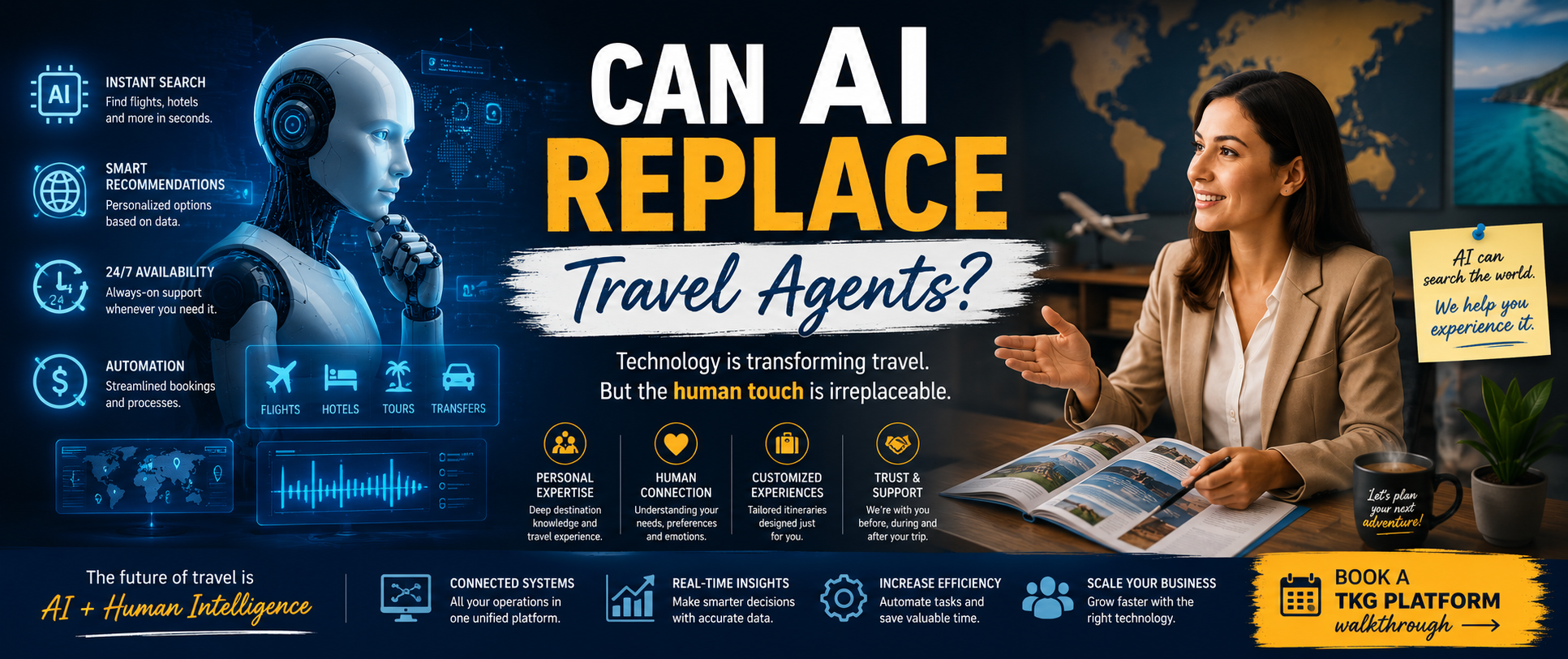
Can AI Replace Travel Agents?
Why the future of travel is more likely to be AI supported rather than fully AI replaced
Artificial Intelligence is transforming the travel industry at an incredible pace.
AI can now:
- answer customer questions
- recommend destinations
- automate bookings
- personalise travel suggestions
- generate itineraries
- manage customer communication
- analyse customer data
As AI continues evolving, one question is being asked more frequently across the tourism industry:
- “Will AI replace travel agents?”
It is a fair question.
Because many industries are already experiencing major disruption from automation and AI driven systems.
But after spending many years working across both travel operations and travel technology, my view is very clear:
AI will absolutely transform the role of travel agents, but it is unlikely to fully replace great travel advisors.
Why?
Because travel is not simply transactional.
Travel is emotional, personal, complex, and deeply human.
And while AI can automate many operational tasks, it still cannot fully replace:
- emotional understanding
- human trust
- relationship building
- empathy
- creativity
- experience-based judgement
The future of travel will not be AI versus travel agents.
The future will be travel agents empowered by AI.
And the agencies that learn how to combine intelligent technology with exceptional human service will become stronger than ever before.

1. AI is excellent at automation
There is no doubt that AI can dramatically improve operational efficiency in tourism.
AI can help automate:
- repetitive customer enquiries
- booking confirmations
- itinerary generation
- follow up communication
- marketing workflows
- customer segmentation
- reporting tasks
This reduces enormous amounts of manual administrative work.
For travel businesses, this is incredibly valuable.
AI allows teams to:
- save time
- reduce operational pressure
- improve response speed
- scale more efficiently
But automation is only one part of the customer journey.
2. Travel is deeply emotional
People do not travel simply to move from one destination to another.
They travel for:
- family memories
- celebrations
- cultural experiences
- personal growth
- wellness
- relaxation
- emotional connection
Travel decisions are often highly emotional.
Customers frequently seek:
- reassurance
- guidance
- confidence
- expert recommendations
- emotional understanding
Especially when planning:
- luxury holidays
- family trips
- honeymoons
- cruises
- once-in-a-lifetime journeys
- complex itineraries
- AI may provide information.
But emotional trust is still built through human relationships.
3. Complex travel still requires human expertise
Many travel bookings are far more complicated than simple online transactions.
Travel agents often manage:
- multi-country itineraries
- visa requirements
- supplier coordination
- cruise planning
- emergency changes
- family travel logistics
- luxury experiences
- special requests
These situations require:
- experience
- judgement
- flexibility
- problem-solving
- human communication
AI can assist with information and workflow automation, but complex travel planning still benefits enormously from experienced travel professionals.
4. Customers still value trust and reassurance
One of the biggest reasons travellers use travel agents is trust.
Customers want to know:
- someone is accountable
- someone can assist if problems arise
- someone understands their needs
- someone can provide expert advice
This becomes even more important during:
- travel disruptions
- emergencies
- flight cancellations
- unexpected changes
AI may provide automated responses.
But during stressful situations, travellers often want real human support.
Trust remains one of the most valuable assets in tourism.
5. AI will change the role of travel agents
While AI may not fully replace travel agents, it will absolutely reshape their role.
Travel advisors will likely spend: less time on:
- repetitive administration
- manual processes
- basic enquiries
and more time on:
- relationship building
- personalised travel design
- customer experience
- luxury consulting
- complex itinerary planning
- high-value sales
In many ways, AI will elevate the role of travel advisors rather than eliminate it.
The future travel advisor will become more strategic, consultative, and experience-focused.
6. AI improves personalisation opportunities
AI can help travel agents better understand customers through:
- customer data analysis
- booking behaviour
- travel preferences
- predictive recommendations
This allows travel businesses to deliver more personalised experiences.
For example: AI may help identify:
- luxury travel preferences
- wellness interests
- preferred destinations
- ideal future travel recommendations
The TKG Travel CRM vision strongly supports this future of AI assisted customer relationship management.
AI helps advisors personalise at scale more effectively.
7. The best travel experiences still require human creativity
Travel is not only about logistics.
It is also about:
- storytelling
- creativity
- emotional understanding
- destination passion
- cultural insight
Great travel advisors create experiences that feel:
- unique
- personal
- meaningful
Human creativity remains one of the strongest differentiators in premium and experiential travel.
AI can support ideas.
But truly exceptional travel design still relies heavily on human imagination and understanding.
8. Luxury travel will remain highly relationship driven
Luxury travel clients often expect:
- personalised attention
- trusted advisors
- concierge-style service
- human communication
- relationship-based support
High-value travellers frequently prefer working with experienced travel professionals they trust.
Luxury tourism is deeply relationship driven.
This is one reason luxury travel advisors continue to remain highly valuable even as technology evolves.
9. AI helps travel agents become more productive
One of the biggest advantages of AI is productivity improvement.
AI helps travel businesses:
- automate repetitive tasks
- improve response times
- streamline operations
- personalise communication
- manage customer data more efficiently
This allows travel agents to:
- focus on higher value work
- improve customer service
- manage more clients
- scale more effectively
AI becomes a business enhancement tool rather than simply a replacement technology.
10. Customers increasingly want both technology and human support
Modern travellers expect:
- digital convenience
- fast responses
- mobile access
- seamless communication
But they also still value:
- expertise
- reassurance
- emotional connection
- trusted advice
The future of tourism will likely combine:
- AI-powered efficiency
- human-centred service
The strongest travel businesses will balance both effectively.
11. AI may replace transactional travel, but not relationship driven travel
Simple transactional bookings are already becoming highly automated.
For example:
- simple hotel bookings
- airline bookings
- basic package bookings
- may increasingly rely on AI and self-service platforms.
But relationship-driven travel sectors such as:
- luxury travel
- small group touring
- experiential travel
- wellness tourism
- complex itineraries
- high touch customer service
- will continue benefiting strongly from human expertise.
The more emotional and personalised the travel experience becomes, the more valuable human advisors remain.
12. Travel agents who resist technology may struggle
While AI may not replace travel agents entirely, travel agents who refuse to adapt to technology may struggle competitively.
Modern travel businesses need:
- CRM systems
- automation
- AI supported operations
- integrated platforms
- customer data visibility
Technology is becoming essential infrastructure for modern tourism businesses.
The future belongs to travel companies that combine:
- human expertise
- operational efficiency
- intelligent technology
- together.
13. The future travel advisor will be AI-supported
The next generation of successful travel advisors will likely use AI to:
- improve productivity
- personalise customer experiences
- automate workflows
- enhance marketing
- improve operational visibility
AI will help travel professionals become:
- more efficient
- more strategic
- more customer-focused
- more scalable
Technology should empower travel advisors, not replace them.
At TKG Platform, this is one of our core beliefs.
14. Human connection will remain the heart of tourism
No matter how advanced AI becomes, tourism will remain deeply human.
People travel for:
- experiences
- emotions
- memories
- connection
- cultural discovery
- personal enrichment
Technology can improve operations and convenience.
But meaningful customer relationships are still built through:
- trust
- empathy
- expertise
- care
- emotional understanding
The travel businesses that combine intelligent technology with authentic human service will lead the future of tourism.
Final Thought
AI will absolutely transform the travel industry.
It will automate workflows, improve efficiency, personalise experiences, and reshape travel operations.
But AI is unlikely to fully replace great travel agents.
Instead, AI will help travel professionals:
- work smarter
- personalise better
- respond faster
- scale more efficiently
- focus more on customer relationships
The future of tourism is not AI versus humans.
It is AI supporting humans to create better travel experiences.
At TKG Platform, we believe the future of travel belongs to businesses that combine:
- intelligent technology
- operational excellence
- automation
- customer understanding
- human connection
- Because while technology may simplify travel
- people will always remember how the journey made them feel.
Written by Thuy Carroll
Founder & Chief Innovation Officer | TKG Platform
Transforming Travel Through Technology
www.tkgplatform.com.au