
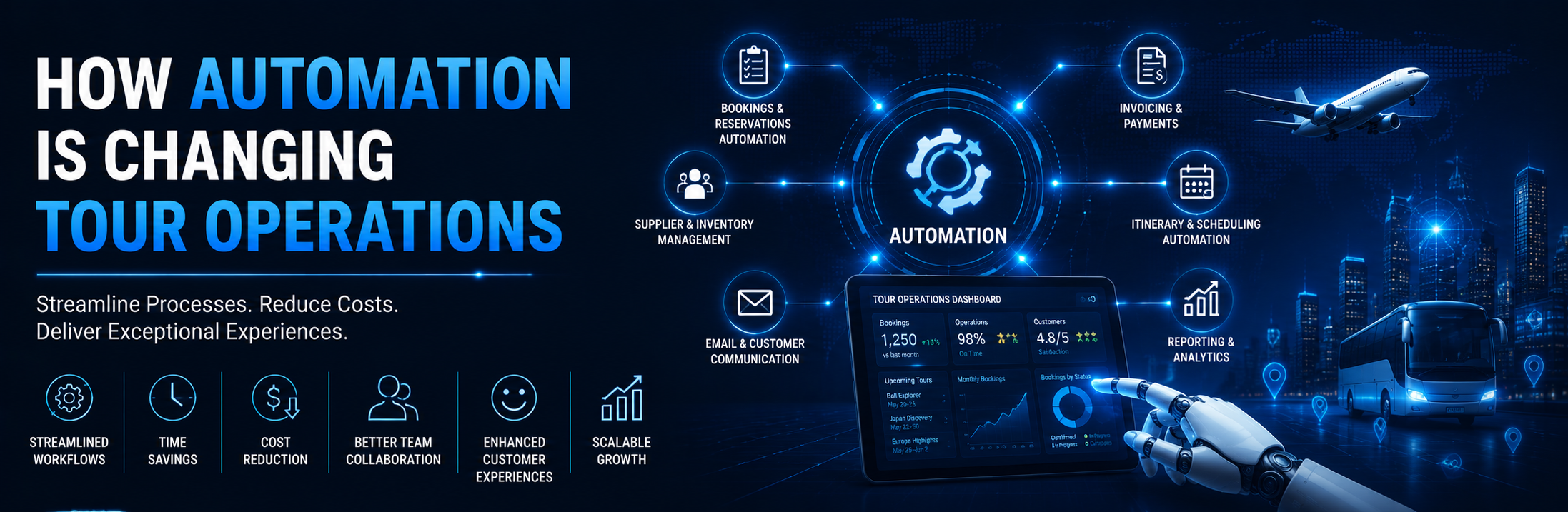
How Automation Is Changing Tour Operations
Why the future of tour operations is smarter, faster, and more connected
The travel industry has always been one of the most operationally complex industries in the world.
Behind every successful tour is an enormous amount of coordination happening behind the scenes:
- bookings
- supplier confirmations
- rooming lists
- transportation schedules
- payments
- passenger details
- special requests
- travel documents
- guides
- operations teams
- emergency support
- customer communication
For many tour operators, managing all of this manually has become increasingly difficult.
As customer expectations rise and competition grows, the pressure on operations teams continues to increase.
This is exactly why automation is becoming one of the biggest transformations in modern tour operations.
Automation is no longer just a 'technology upgrade.' It is becoming essential for survival, scalability, and growth.
And in my view, the future of successful tour operators will depend heavily on how intelligently they automate their business.
1. Tour operations are becoming too complex for manual systems
Years ago, many tour operators could manage operations using:
- spreadsheets
- emails
- printed documents
- manual checklists
- staff memory
But the industry has changed dramatically.
Today's tour businesses often manage:
- multiple destinations
- global suppliers
- complex itineraries
- customised travel experiences
- online bookings
- mobile travellers
- last-minute changes
- real-time customer expectations
At the same time, businesses are trying to:
- grow sales
- reduce costs
- improve customer service
- manage staff workloads
- increase efficiency
Manual systems simply cannot keep up with the scale and speed of modern travel operations.
2. Automation reduces repetitive operational tasks
One of the biggest advantages of automation is reducing repetitive admin work.
Many operations teams spend hours every day on tasks such as:
- sending confirmations
- updating booking statuses
- preparing documents
- checking payments
- sending reminders
- updating rooming lists
- managing passenger information
- following up suppliers
These tasks are important, but they are also time-consuming.
Automation helps eliminate unnecessary manual work by allowing systems to:
- send automatic confirmations
- generate invoices
- issue vouchers
- track booking status
- notify teams of changes
- organise passenger data
- automate reminders and follow-ups
This allows staff to focus on higher-value work instead of repetitive administration.
3. Faster operations improve customer experience
Modern travellers expect fast and seamless service.
They want:
- quick confirmations
- easy access to documents
- real-time updates
- smooth communication
- organised itineraries
Automation helps tour operators deliver this experience more consistently.
For example:
- customers can receive automatic booking confirmations instantly
- travel documents can be delivered digitally
- itinerary updates can be sent in real time
- reminders can be automated before departure
- support communication becomes more streamlined
The customer experience becomes smoother and more professional.
And in today's travel industry, customer experience is one of the biggest competitive advantages.
4. Automation helps tour operators scale more efficiently
One of the biggest challenges for tour operators is growth.
As bookings increase, operational workload increases even faster.
Without automation, businesses often face:
- overwhelmed staff
- slower response times
- more mistakes
- operational bottlenecks
- inconsistent service quality
This creates a growth ceiling.
Eventually, the business reaches a point where more bookings create more pressure rather than more profit.
Automation changes this.
By streamlining workflows and reducing manual workload, businesses can handle larger booking volumes without needing to increase staffing at the same rate.
This creates scalability.
And scalability is critical for long-term business growth.
5. Automation reduces human error
Tour operations involve enormous amounts of information.
A small mistake can create major problems:
- wrong travel dates
- incorrect passenger names
- missing supplier confirmations
- inaccurate rooming lists
- missed payments
- lost documents
Manual systems increase the risk of these errors.
Automation helps reduce mistakes by:
- standardising workflows
- centralising information
- automatically updating records
- reducing duplicate data entry
- tracking operational tasks more clearly
This creates better accuracy and stronger operational control.
In travel, operational reliability builds trust.
6. Real-time visibility is changing operations management
Traditional operations often rely on fragmented communication and delayed updates.
Managers may struggle to know:
- which bookings are confirmed
- which suppliers are pending
- which passengers still require documents
- which payments are overdue
- where operational bottlenecks exist
Modern automated systems provide real-time visibility across operations.
This allows businesses to:
- monitor workflows more efficiently
- identify issues early
- track team performance
- improve coordination
- make faster decisions
In the future, real-time operational visibility will become standard for successful travel businesses.
7. Automation supports better team productivity
One hidden benefit of automation is staff wellbeing.
Operations teams in travel often work under high pressure, especially during:
- peak travel periods
- last-minute changes
- disruptions
- group departures
- emergency situations
When teams spend too much time on repetitive admin, burnout increases.
Automation helps reduce unnecessary operational stress.
Instead of spending hours manually processing tasks, teams can focus on:
- customer care
- problem solving
- supplier relationships
- quality control
- strategic improvements
Technology should support people, not overwhelm them.
The best travel businesses understand this.
8. Automation is changing communication in travel
Communication is one of the most important parts of tour operations.
Tour operators communicate constantly with:
- travellers
- suppliers
- hotels
- guides
- drivers
- agents
- internal teams
Automation is improving communication by enabling:
- automatic notifications
- real-time updates
- workflow alerts
- centralised communication records
- faster response handling
This creates better coordination and reduces operational confusion.
In a global industry like travel, communication speed matters enormously.
9. The future of tour operations is connected systems
One major issue many tour operators still face is disconnected technology.
Some businesses use:
- spreadsheets for operations
- emails for communication
- separate accounting systems
- separate CRM systems
- manual reporting tools
This fragmentation creates inefficiency.
The future of tour operations is integrated platforms where:
- CRM
- operations
- bookings
- customer communication
- reporting
- payments
- documentation
- automation
all work together in one connected ecosystem.
This is one of the reasons platforms like TKG Platform are becoming increasingly important for modern travel businesses.
Tour operators do not need more systems.
They need smarter, connected systems.
10. Automation will become essential for competitiveness
The reality is simple.
The travel businesses that embrace intelligent automation will:
- operate more efficiently
- scale faster
- reduce operational costs
- improve customer service
- respond more quickly
- create better team productivity
- gain stronger business insights
Meanwhile, businesses relying heavily on outdated manual workflows may struggle to compete.
The industry is moving too fast.
Traveller expectations are too high.
Operational complexity is too great.
Automation is no longer a luxury.
It is becoming part of the foundation of modern travel operations.
Final Thought
Automation is changing tour operations in powerful ways.
But the future is not about removing people from travel.
It is about removing unnecessary inefficiency.
The goal of automation should never be to replace human expertise, care, and relationships.
The goal should be to:
- simplify operations
- reduce pressure
- improve consistency
- support growth
- enhance customer experiences
At TKG Platform, we believe technology should help travel businesses operate smarter while keeping the human touch at the centre of everything they do.
Because behind every successful automated system, there should still be passionate people creating unforgettable travel experiences.
The future of tour operations is not just automated.
It is intelligent, connected, scalable, and human-centred.
Written by Thuy Carroll
Founder & Chief Innovation Officer | TKG Platform
Transforming Travel Through Technology
www.tkgplatform.com.au