
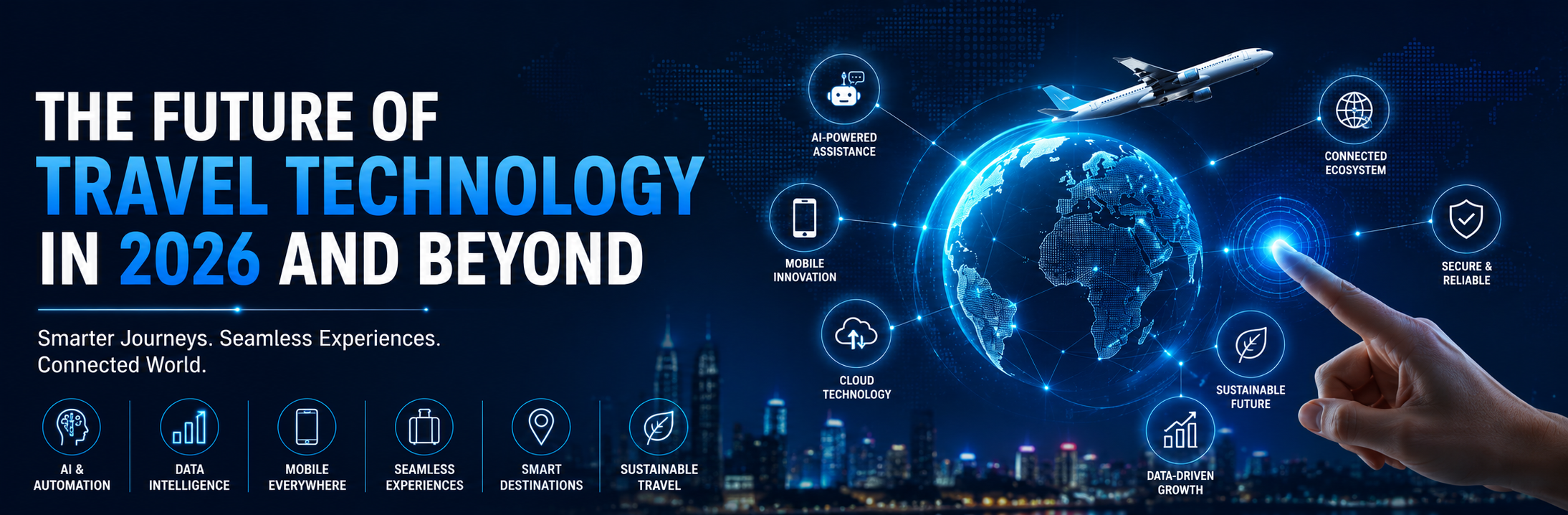
The Future of Travel Technology in 2026 and Beyond
Why the next generation of travel businesses must become smarter, faster, and more connected
The travel industry has always been about people. It is about dreams, culture, connection, service, and trust. But in 2026 and beyond, the businesses that will lead the travel industry will not only be the ones with beautiful products or strong relationships. They will be the ones that know how to combine human expertise with intelligent technology.
Technology is no longer something travel businesses can “think about later.” It is now part of how we sell, operate, serve clients, manage data, and grow.
Reports from WTTC and Trip.com Group show that major technologies such as AI, 5G, fintech, sustainable mobility, and digital platforms are already reshaping travel and tourism worldwide. Their 2026 report highlighted 16 transformative technologies expected to redefine the sector. (World Travel & Tourism Council)
For me, the future of travel technology is not about replacing people. It is about giving travel businesses the tools to work smarter, serve better, and grow stronger.

1. AI will become the new business assistant
AI is changing how travellers research, plan, book, and experience their holidays. By 2026, AI-powered trip planning, smart recommendations, and automated customer support are becoming normal expectations, not futuristic ideas. Amadeus’ Travel Trends 2026 report highlights AI-powered trip planning as one of the major shifts transforming travel. (amadeus.com)
But the real opportunity is not only for the traveller. The bigger opportunity is for travel businesses.
AI can help tour operators, DMCs, wholesalers, and travel agencies:
- respond faster to enquiries
- create better itineraries
- understand customer preferences
- automate repetitive admin tasks
- support sales teams
- improve marketing
- reduce operational pressure
However, AI without travel knowledge is not enough. Travel is complex. It has suppliers, contracts, seasonality, pricing, availability, special requests, visas, rooming lists, passenger details, and after-sales service.
That is why the future is not just “AI.” The future is AI built around real travel operations.
This is where platforms like TKG Platform matter. Travel businesses need technology that understands the way the industry actually works.
2. Personalisation will become the new standard
Travellers no longer want generic travel. They want journeys that feel designed for them.
Amadeus identifies hyper-personalised stays as one of the trends shaping 2026 travel, while Expedia’s Unpack ’26 report shows travellers are looking for more distinctive, experience-led trips rather than traditional holidays. (amadeus.com)
This creates a big challenge for travel businesses.
Personalisation takes time. It requires customer data, preferences, history, communication records, product knowledge, and fast response. Without the right system, personalisation becomes manual and expensive.
In the future, successful travel companies will not only know the customer’s name. They will know:
- what style of travel they prefer
- what budget range suits them
- what destinations interest them
- what experiences they value
- when they usually travel
- whether they prefer premium, luxury, family, wellness, cruise, golf, or cultural travel
This is why CRM, automation, customer profiling, and data-driven sales tools will become essential.
The companies that understand their clients better will win more bookings.
3. Mobile-first travel will become non-negotiable
Travellers already expect everything on their phone: documents, vouchers, itineraries, maps, payments, updates, and support.
IATA’s One ID initiative shows the direction of travel: a more seamless passenger journey using digital identity and biometric recognition. (IATA)
This tells us something very important. The traveller journey is becoming more digital from beginning to end.
For travel businesses, this means the future client experience must include:
- digital itineraries
- online payments
- mobile-accessible vouchers
- real-time trip information
- automated notifications
- easy communication
- secure passenger data collection
A beautiful brochure is no longer enough. A PDF itinerary is no longer enough. Clients want convenience, speed, and confidence.
This is why the travel app experience will become a major competitive advantage.
4. Automation will separate growing businesses from struggling businesses
Many travel companies are still running on email, spreadsheets, manual follow-up, and disconnected systems.
This may work when the business is small. But when enquiries increase, bookings grow, and staff become busy, manual systems create mistakes.
The future of travel technology is about automation across the full business workflow:
- enquiry management
- quote creation
- booking confirmation
- supplier communication
- invoice and payment tracking
- passenger documents
- task reminders
- marketing follow-up
- customer service
- reporting and dashboards
Automation does not remove the human touch. It protects it.
When staff spend less time doing repetitive admin, they have more time to sell, care, problem-solve, and build relationships.
That is the real value of technology.
5. Connected platforms will replace disconnected tools
One of the biggest problems in travel businesses is that everything is separate.
One system for CRM.
One system for booking.
One spreadsheet for products.
One inbox for enquiries.
One folder for documents.
One accounting process.
One marketing platform.
One reporting method.
This creates confusion, duplication, and lost opportunities.
In 2026 and beyond, travel companies will move towards integrated platforms where sales, operations, marketing, customer data, booking management, documents, and reporting work together.
This is one of the reasons TKG Platform was created: to support travel and tourism businesses with practical technology built by people who understand the industry.
A travel business does not just need software. It needs a connected ecosystem.
6. Data will become one of the most valuable assets in travel
Many travel companies have years of valuable customer data but do not use it properly.
They may know who booked Vietnam last year, who prefers river cruising, who travels as a family, who likes luxury hotels, or who usually books 12 months in advance, but that information is often hidden in emails, old files, or staff memory.
The future travel business must treat data as an asset.
Good data helps companies:
- market to the right customers
- increase repeat bookings
- improve conversion rates
- forecast demand
- understand product performance
- track staff sales activity
- identify profitable destinations
- make better business decisions
Without data, business owners guess. With data, they lead.
7. Sustainability and responsible travel will be supported by technology
Sustainability is no longer just a marketing message. It is becoming part of how destinations, governments, and businesses plan the future of tourism.
UN Tourism continues to position digital transformation and sustainability as important priorities for the sector. (untourism.int)
Technology can support responsible travel by helping businesses:
- manage visitor flows
- reduce paper documents
- promote local suppliers
- track operational efficiency
- provide better destination information
- support more transparent decision-making
The future is not only about selling more travel. It is about selling better travel.
8. The human touch will become more valuable, not less
Some people worry that technology will take away the human side of travel.
I believe the opposite.
As technology becomes smarter, the human touch becomes even more important.
AI can suggest an itinerary, but a trusted travel expert understands emotion.
Automation can send a reminder, but a real person builds confidence.
A platform can manage data, but leadership creates culture.
Technology can support service, but people deliver care.
In premium and luxury travel, especially, trust is everything.
The winners will be travel businesses that use technology to strengthen relationships, not replace them.
9. Travel businesses must invest before they are forced to change
Many businesses wait until they are overwhelmed before they invest in technology.
But by then, they may already be losing leads, staff productivity, customer trust, and profit.
The best time to modernise is before the pressure becomes too big.
Travel businesses should now be asking:
- Can my team handle more bookings without more admin pressure?
- Do I know where every enquiry is up to?
- Can I track sales performance clearly?
- Can I personalise marketing properly?
- Can clients access their documents easily?
- Can I scale without losing service quality?
- Do I have the right technology foundation for the next five years?
The future will reward businesses that prepare early.
10. My view: technology must be practical, not complicated
At TKG Platform, our belief is simple.
Technology should make business easier.
It should not create more confusion. It should not be too difficult for staff to use. It should not be designed by people who do not understand the travel industry.
The future of travel technology must be:
- practical
- connected
- scalable
- secure
- user-friendly
- built for real travel workflows
- designed to support growth
Travel businesses do not need technology for the sake of technology. They need technology that helps them sell more, operate better, protect their brand, and serve clients with confidence.
Final Thought
The future of travel technology in 2026 and beyond is not about choosing between people and technology.
It is about bringing them together.
The most successful travel companies will be those that keep the heart of travel, service, trust, culture, and experience, while using technology to become more efficient, intelligent, and connected.
The world is moving fast. Traveller expectations are changing. Competition is growing. Costs are increasing. Staff are under pressure.
But for travel businesses willing to modernise, this is also one of the greatest opportunities we have ever seen.
At TKG Platform, we believe the future belongs to travel businesses that are brave enough to innovate, smart enough to adapt, and committed enough to keep the human touch at the centre of everything they do.
Because technology can power the journey, but people create the experience.
Written by Thuy Carroll
Founder & Chief Innovation Officer | TKG Platform
Transforming Travel Through Technology