
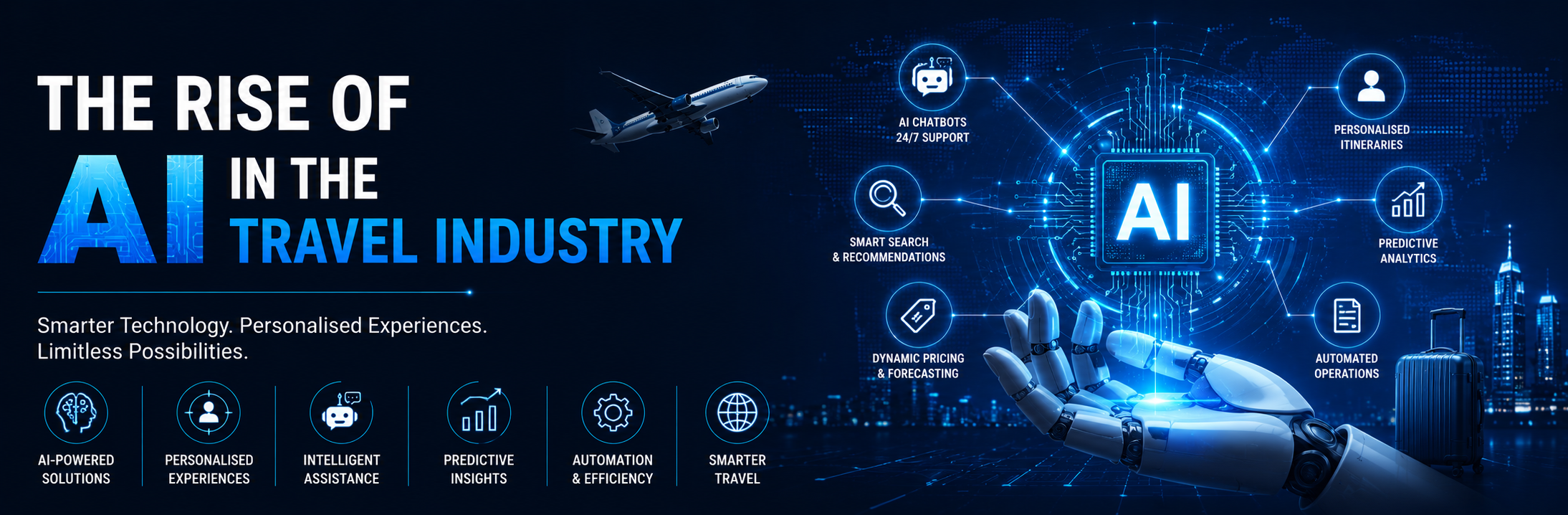
The Rise of AI in the Travel Industry
How Artificial Intelligence is transforming the future of travel, tourism, and customer experience
Artificial Intelligence is no longer a future concept in the travel industry.
It is already here.
From personalised travel recommendations and AI-powered customer service to automated operations and intelligent data analysis, AI is rapidly changing how travel businesses operate and how travellers experience the world.
But despite all the excitement around AI, many travel businesses are still asking the same important question:
"What does AI actually mean for us?"
As someone who has spent decades in both travel and technology, I believe the rise of AI is not about replacing travel professionals. It is about helping travel businesses become smarter, faster, more efficient, and more connected.
The travel industry has always been built on relationships, trust, and human experiences. AI should enhance those strengths, not remove them.
The businesses that understand how to combine human expertise with intelligent technology will lead the future of tourism.

1. AI is changing traveller expectations
Modern travellers now expect:
- instant responses
- personalised recommendations
- seamless booking experiences
- fast customer service
- real-time travel information
- mobile accessibility
- intelligent suggestions
This shift has been heavily influenced by the rise of AI across other industries.
Consumers are already using AI in:
- online shopping
- entertainment
- banking
- healthcare
- customer support
- search engines
Naturally, they now expect the same level of convenience and personalisation when they travel.
The travel industry is moving from 'one-size-fits-all' experiences toward highly personalised journeys.
AI is helping make that possible.
2. AI-powered personalisation is transforming travel planning
One of the most powerful uses of AI in travel is personalisation.
AI can analyse:
- customer preferences
- booking history
- browsing behaviour
- travel patterns
- spending habits
- destination interests
to create smarter travel recommendations.
Instead of offering generic travel packages, businesses can now provide:
- personalised itineraries
- customised experiences
- targeted promotions
- relevant upselling opportunities
- tailored destination suggestions
For example: A traveller interested in wellness holidays may receive recommendations for Sri Lanka retreats, spa resorts, yoga experiences, and cultural wellness journeys.
A luxury river cruise customer may receive tailored offers based on their preferred cabin style, dining interests, and travel season.
This level of personalisation creates stronger customer engagement and higher conversion rates.
3. AI is improving customer service
The travel industry operates 24 hours a day across multiple time zones.
Customers expect support at all times, especially during:
- flight disruptions
- emergencies
- booking changes
- destination questions
- travel updates
AI-powered customer service tools are helping businesses respond faster and more efficiently.
This includes:
- AI chat support
- automated enquiry handling
- intelligent FAQ systems
- multilingual communication
- instant booking assistance
AI can help answer routine questions quickly, allowing travel consultants to focus on more complex customer needs.
This does not remove the human touch.
Instead, it reduces repetitive tasks and improves response times.
The best travel businesses will use AI to support their teams, not replace them.
4. AI is helping travel businesses automate operations
Many travel companies still rely heavily on manual processes.
This creates:
- operational bottlenecks
- staff pressure
- slower response times
- higher risk of mistakes
AI is helping automate many repetitive operational tasks, including:
- itinerary creation
- data entry
- lead management
- supplier communication
- booking follow-up
- reporting
- customer segmentation
- marketing automation
This creates major efficiency improvements.
For growing travel businesses, automation becomes extremely important because scaling manually becomes difficult and expensive.
The future belongs to travel businesses that can scale intelligently.
5. AI is becoming a powerful sales and marketing tool
Travel marketing is becoming more competitive every year.
AI is helping businesses:
- understand customer behaviour
- predict travel trends
- improve targeting
- optimise advertising
- personalise email marketing
- identify sales opportunities
Instead of sending the same campaign to every customer, AI allows businesses to deliver more relevant content to the right audience.
For example:
- golf travellers receive golf holiday promotions
- river cruise clients receive luxury cruise offers
- family travellers receive school holiday packages
- wellness travellers receive retreat recommendations
Smarter marketing leads to:
- higher engagement
- better conversion rates
- improved customer loyalty
- more repeat bookings
In the future, businesses that use customer data intelligently will have a major competitive advantage.
6. AI will reshape how travel businesses make decisions
One of the biggest advantages of AI is its ability to analyse large amounts of information quickly.
Travel businesses generate enormous amounts of data every day:
- enquiries
- bookings
- customer preferences
- supplier performance
- sales activity
- destination demand
- marketing results
AI can help business owners identify:
- which destinations are growing
- which products are most profitable
- which consultants perform best
- which marketing campaigns generate results
- which customers are most valuable
This creates smarter decision-making.
Instead of relying purely on instinct, businesses can combine experience with intelligent data insights.
7. AI is creating opportunities for smaller travel businesses
In the past, advanced technology was often only accessible to large corporations.
Today, AI tools are becoming more accessible to small and medium-sized travel businesses.
This is a major shift.
Smaller agencies, tour operators, and DMCs can now access:
- automation tools
- intelligent CRM systems
- AI-powered marketing
- advanced analytics
- smart communication systems
This helps level the playing field.
A smaller travel business with the right technology can now compete more effectively with much larger companies.
This is one of the most exciting changes happening in the industry.
8. AI will not replace travel professionals
There is a lot of discussion about whether AI will replace travel agents.
My belief is simple:
No technology can replace genuine human connection, empathy, trust, and experience.
Travel is emotional.
People travel for:
- celebrations
- family moments
- culture
- adventure
- wellness
- education
- life experiences
When problems happen during travel, customers still want reassurance from real people.
AI may assist with:
- speed
- automation
- recommendations
- information processing
But human expertise remains critical, especially in:
- luxury travel
- complex itineraries
- group travel
- cruise holidays
- tailor-made experiences
- crisis management
The future is not AI versus people.
The future is AI supporting people.
9. The biggest risk is businesses failing to adapt
Some travel businesses are still waiting to see whether AI matters.
But the reality is that customer expectations are already changing.
Businesses that ignore technology risk:
- slower operations
- lower efficiency
- reduced competitiveness
- weaker customer experiences
- lost sales opportunities
The industry is evolving quickly.
Businesses do not need to adopt every new trend immediately.
But they do need to start preparing for the future.
The companies that modernise early will be in a much stronger position over the next five years.
10. The future of AI in travel must remain human-centred
At TKG Platform, we believe AI should serve the travel industry, not control it.
Technology should:
- simplify operations
- empower staff
- improve customer experiences
- support business growth
- provide better insights
- reduce unnecessary admin
But it should always support the human side of travel.
The most successful travel businesses in the future will combine:
- intelligent systems
- strong leadership
- customer understanding
- operational excellence
- genuine care
AI is a powerful tool.
But people remain the heart of the travel industry.
Final Thought
The rise of AI in the travel industry is one of the biggest transformations tourism has ever experienced.
It is changing how businesses operate, how travellers book, and how customer experiences are delivered.
But the future of travel is not about replacing people with machines.
It is about using intelligent technology to create better experiences, stronger businesses, and more meaningful customer relationships.
Travel businesses that embrace AI thoughtfully and strategically will become:
- more efficient
- more scalable
- more responsive
- more competitive
- more customer-focused
At TKG Platform, we believe the future belongs to travel businesses that are willing to innovate while keeping the human touch at the centre of everything they do.
Because technology can automate processes.
But only people can create unforgettable journeys.
Written by Thuy Carroll
Founder & Chief Innovation Officer | TKG Platform
Transforming Travel Through Technology
www.tkgplatform.com.au