
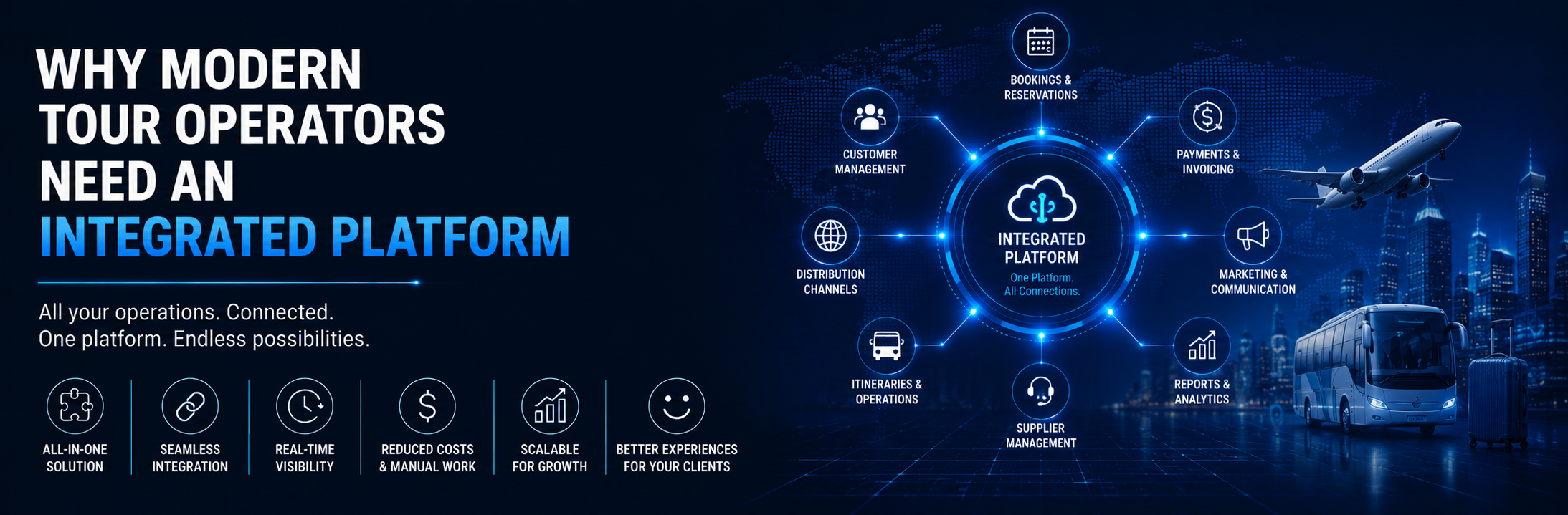
Why Modern Tour Operators Need an Integrated Platform
The future of travel operations is connected, intelligent, and scalable
The travel industry has become significantly more complex over the past decade.
Today’s tour operators are no longer simply selling tours.
They are managing:
- global suppliers
- customer relationships
- online bookings
- operations teams
- marketing campaigns
- travel documents
- payments
- reporting
- mobile experiences
- customer communication
- automation
- data security
- real-time traveller expectations
At the same time, customers now expect faster service, personalised experiences, and seamless communication throughout their journey.
Yet surprisingly, many tour operators are still running their businesses using disconnected systems, spreadsheets, manual workflows, and outdated technology.
This creates operational inefficiency, staff pressure, slower growth, and inconsistent customer experiences.
The reality is simple:
Modern tour operators can no longer rely on fragmented systems if they want to remain competitive.
This is why integrated travel platforms are becoming one of the most important investments for the future of the travel industry.

1. Tour operations are becoming too complex for disconnected systems
Many travel businesses still operate using multiple separate tools:
- CRM systems
- spreadsheets
- accounting software
- email communication
- booking systems
- supplier documents
- manual reporting tools
- external apps
Each system may perform one task well, but the problem is that they often do not communicate with each other properly.
This creates operational silos.
As a result:
- staff duplicate work
- information becomes inconsistent
- reporting becomes difficult
- communication slows down
- mistakes increase
- productivity decreases
Over time, the business becomes harder to manage instead of easier to grow.
An integrated platform solves this problem by bringing operations, sales, customer management, communication, and reporting into one connected ecosystem.
2. Integrated platforms improve operational efficiency
One of the biggest challenges in travel operations is time.
Operations teams spend enormous amounts of time:
- updating records
- searching for information
- sending repetitive emails
- checking booking statuses
- tracking payments
- managing passenger documents
- coordinating suppliers
When systems are disconnected, simple tasks take much longer.
An integrated platform allows information to flow automatically across the business.
For example:
- booking data updates instantly
- customer information remains centralised
- documents become easier to access
- communication records stay connected
- workflows become automated
This dramatically improves operational efficiency.
And in travel, efficiency directly impacts profitability.
3. Better customer experiences require connected systems
Today’s travellers expect smooth and professional experiences.
They want:
- fast responses
- accurate information
- seamless communication
- digital documents
- mobile-friendly access
- personalised service
But delivering this consistently becomes difficult when teams are managing multiple disconnected systems.
Integrated platforms help create better customer experiences because everything is connected:
- enquiries
- itineraries
- payments
- communications
- documents
- customer preferences
- travel updates
When teams have complete visibility, service quality improves significantly.
Customers notice professionalism.
And in the travel industry, trust and customer experience drive repeat business.
4. Integrated platforms support business growth
Many tour operators eventually reach a growth ceiling.
Not because demand is weak.
But because operations become too difficult to manage manually.
As bookings increase:
- admin workload increases
- staff become overwhelmed
- response times slow down
- mistakes become more common
Without the right systems, growth creates pressure rather than scalability.
Integrated platforms help businesses scale more effectively by:
- automating workflows
- centralising information
- improving visibility
- reducing duplication
- streamlining communication
This allows businesses to grow without increasing operational chaos.
The future belongs to tour operators that can scale intelligently.
5. Real-time visibility improves decision-making
Many travel businesses struggle with visibility.
Business owners often ask:
What is happening across operations right now?
Which bookings are confirmed?
Which suppliers are outstanding?
Which consultants are performing best?
Which products are most profitable?
Where are operational bottlenecks occurring?
Disconnected systems make answering these questions difficult.
Integrated platforms provide centralised reporting and real-time business insights.
This allows operators to:
- make faster decisions
- identify issues early
- monitor performance
- improve forecasting
- track sales pipelines
- measure operational efficiency
In the modern travel industry, data-driven businesses will outperform businesses relying only on instinct.
6. Automation becomes more powerful with integration
Automation works best when systems are connected.
If systems are disconnected, automation becomes limited because information cannot move freely between departments and workflows.
Integrated platforms enable automation across the entire customer journey:
- lead management
- quotation workflows
- booking confirmations
- invoicing
- supplier coordination
- customer notifications
- reporting
- post-travel follow-up
This reduces repetitive admin work and improves consistency.
Automation is no longer just about saving time.
It is about creating smarter, more scalable operations.
7. Integrated platforms improve team collaboration
Travel businesses often involve multiple departments working together:
- sales
- reservations
- operations
- marketing
- finance
- customer support
When systems are fragmented, communication gaps increase.
Teams may:
- miss updates
- duplicate work
- lose information
- misunderstand booking status
- rely too heavily on manual communication
Integrated platforms improve collaboration because everyone works from the same connected system.
This creates:
- greater transparency
- clearer workflows
- stronger accountability
- faster coordination
- improved operational control
The business becomes more organised and less dependent on individual staff knowledge.
8. Modern travellers expect digital experiences
Traveller expectations have changed dramatically.
Customers increasingly expect:
- online access
- digital itineraries
- mobile travel documents
- real-time notifications
- self-service features
- fast communication
Tour operators relying on outdated systems may struggle to meet these expectations consistently.
Integrated platforms help businesses deliver modern digital experiences while maintaining personalised service.
This balance between technology and human care will define the future of successful travel businesses.
9. Data security and compliance are becoming more important
Travel businesses manage highly sensitive customer information:
- passports
- personal details
- payment information
- emergency contacts
- travel history
Managing this data across multiple disconnected systems increases risk.
Integrated cloud-based platforms provide:
- better security
- controlled access
- centralised data management
- improved backup systems
- stronger operational protection
As cyber threats increase globally, modern travel businesses must take technology security seriously.
10. The future of tour operations is connected ecosystems
The next generation of tour operators will not operate with isolated systems.
They will operate with intelligent ecosystems where:
- CRM
- bookings
- operations
- automation
- customer communication
- reporting
- marketing
- payments
- mobile experiences
- all work together seamlessly.
This is why integrated platforms like TKG Platform are becoming increasingly important.
Modern tour operators do not simply need software.
They need a complete operational ecosystem built specifically for the travel industry.
Technology should not create more complexity.
It should simplify complexity.
Final Thought
The travel industry is evolving rapidly.
Customer expectations are higher. Competition is stronger. Operational demands are increasing.
Tour operators that continue relying on fragmented systems may find growth becoming more difficult, more stressful, and less profitable.
The future belongs to businesses that are:
- connected
- data-driven
- automated
- scalable
- customer-focused
Integrated platforms are no longer a luxury for large companies.
They are becoming essential infrastructure for modern travel businesses.
At TKG Platform, we believe technology should help tour operators simplify operations, empower teams, improve customer experiences, and scale with confidence.
Because the future of travel is not just digital.
It is connected, intelligent, and built around people.
Written by Thuy Carroll
Founder & Chief Innovation Officer | TKG Platform
Transforming Travel Through Technology
www.tkgplatform.com.au