
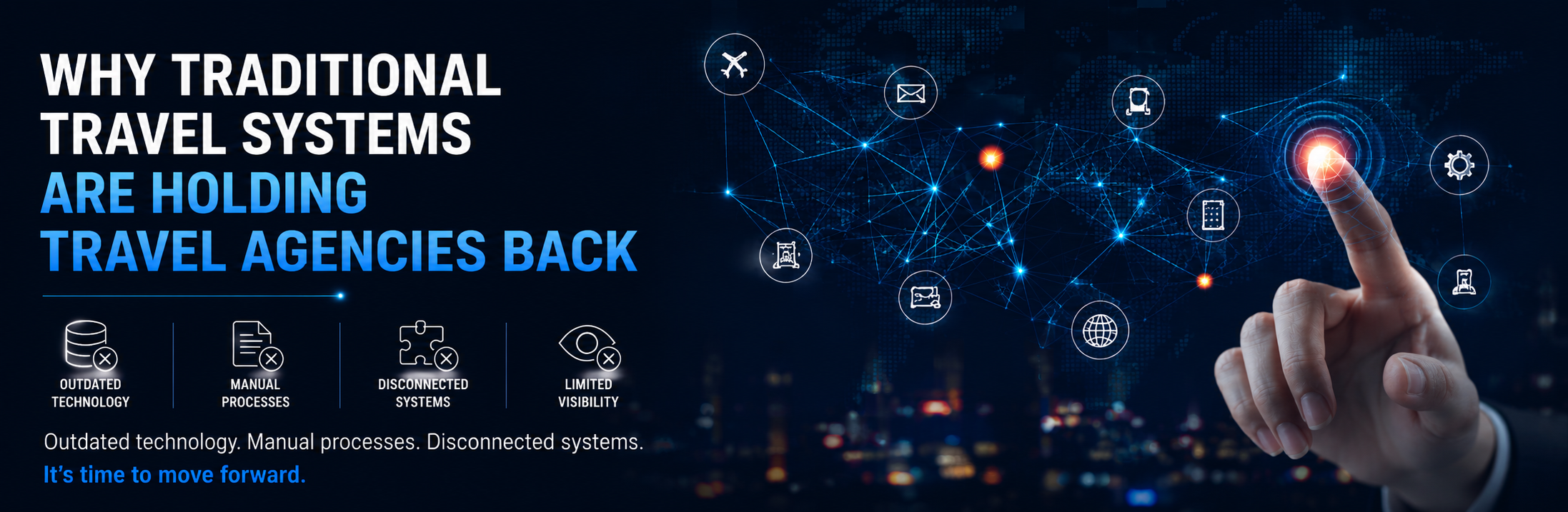
Why Traditional Travel Systems Are Holding Travel Agencies Back
The travel industry has changed, but many travel systems have not
The travel industry today moves faster than ever before.
Customers expect instant responses. Travellers want personalised experiences. Teams work remotely across different countries and time zones. Businesses manage multiple suppliers, channels, payments, marketing campaigns, and customer communications simultaneously.
Yet surprisingly, many travel agencies and tour operators are still relying on systems and workflows designed for the industry of 10 or even 20 years ago.
The reality is this:
Many travel businesses are trying to compete in a modern digital world using outdated technology.
And that is becoming one of the biggest barriers to growth.
As someone who has spent decades in both the travel and technology industries, I have seen firsthand how traditional systems can slow businesses down, frustrate staff, reduce sales opportunities, and limit scalability.
The future of travel belongs to businesses that are willing to modernise.

1. Traditional travel systems were built for a different era
Many legacy travel systems were created at a time when:
- most bookings were manual
- customer expectations were lower
- online competition was limited
- automation was minimal
- mobile technology was not dominant
- AI did not exist
- customer data was rarely utilised properly
Back then, travel businesses could survive with:
- spreadsheets
- manual emails
- disconnected systems
- paper documents
- slow response times
But the travel industry has evolved dramatically.
Today's travellers compare prices instantly, expect real-time communication, want mobile access to travel documents, and demand highly personalised experiences.
The businesses still operating on outdated systems are finding it harder to keep up.
2. Disconnected systems create operational chaos
One of the biggest problems with traditional travel systems is fragmentation.
Many travel businesses use:
- one system for CRM
- another for accounting
- another for supplier management
- spreadsheets for reporting
- emails for operations
- folders for passenger documents
- manual follow-up processes for sales
This creates unnecessary complexity.
Staff waste time:
- searching for information
- duplicating data
- manually updating records
- checking multiple systems
- correcting mistakes
When systems do not communicate properly, businesses lose efficiency.
And in travel, inefficiency costs money.
- It slows down enquiries
- It delays quotes
- It increases errors
- It affects customer experience
- It creates stress for staff
Modern travel businesses need connected ecosystems, not disconnected tools.
3. Manual processes are slowing agencies down
Many traditional travel businesses still rely heavily on manual workflows.
For example:
- manually creating itineraries
- manually sending invoices
- manually updating rooming lists
- manually following up leads
- manually checking supplier confirmations
- manually tracking payments
This may seem manageable at first.
But as businesses grow, manual operations become dangerous.
The business becomes dependent on:
- individual staff knowledge
- staff memory
- staff availability
- endless admin work
Eventually, the business reaches a growth ceiling.
The agency wants more bookings, but the team is already overwhelmed.
This is one of the biggest reasons many travel businesses struggle to scale.
Automation is no longer optional. It is essential.
4. Slow response times are losing bookings
Today's travellers expect speed.
If a customer sends an enquiry, they often expect:
- acknowledgement within minutes
- quick itinerary ideas
- fast pricing
- seamless communication
But outdated systems make speed difficult.
When staff must:
- search emails manually
- build quotes from scratch
- check multiple supplier portals
- copy information between systems
response times slow dramatically.
And in the digital age, slow response times can mean lost sales.
The reality is simple:
The first business to respond professionally often has the highest chance of winning the booking.
Modern travel technology helps agencies move faster without sacrificing service quality.
5. Traditional systems limit personalisation
The future of travel is personalised travel.
Customers no longer want generic holidays. They want experiences tailored to:
- their interests
- travel style
- budget
- preferences
- lifestyle
- previous travel history
But outdated systems often store customer information poorly or not at all.
Many travel agencies have valuable customer insights hidden inside:
- staff memory
- inboxes
- spreadsheets
- disconnected notes
Without proper customer profiling and CRM capabilities, agencies struggle to deliver personalised experiences at scale.
This is a major competitive disadvantage.
The travel businesses that truly understand their customers will dominate the future.
6. Legacy systems make reporting difficult
Many travel business owners do not have real-time visibility into their business performance.
They struggle to answer questions like:
- Which destination is most profitable?
- Which consultant has the best conversion rate?
- Which marketing campaign generated the most enquiries?
- What products are growing fastest?
- What is the business pipeline value?
- Which suppliers perform best?
Traditional systems often produce:
- limited reporting
- outdated data
- incomplete information
- manual spreadsheets
This makes strategic decision-making difficult.
Modern travel businesses need live dashboards, performance tracking, and actionable business insights.
Without data, business owners are guessing.
7. Staff burnout becomes a serious issue
One hidden cost of outdated systems is staff exhaustion.
When teams spend most of their day:
- chasing information
- doing repetitive admin
- fixing errors
- manually processing tasks
they have less time for:
- customer service
- sales
- relationship building
- innovation
- strategic thinking
This creates frustration and burnout.
The travel industry is already highly demanding. Technology should reduce pressure, not increase it.
Modern systems should empower teams, not overwhelm them.
8. Traditional systems struggle to support modern customer expectations
Today's travellers expect:
- mobile-friendly access
- digital itineraries
- online payments
- instant updates
- self-service options
- personalised communication
- seamless booking experiences
Agencies using outdated systems often struggle to deliver this experience consistently.
And travellers notice.
Customer experience is becoming one of the biggest competitive advantages in tourism.
The businesses that make travel easier, smoother, and more connected will build stronger loyalty.
9. Security and compliance risks are increasing
Travel businesses manage highly sensitive customer information:
- passports
- payment details
- travel documents
- personal information
- emergency contacts
Older systems may not provide:
- strong security standards
- modern cloud protection
- proper data management
- compliance support
- secure access control
As cyber threats increase globally, travel businesses must take data security seriously.
Modern cloud-based platforms are becoming increasingly important for protecting both businesses and travellers.
10. The future belongs to connected, intelligent travel platforms
The next generation of travel businesses will operate very differently.
Instead of disconnected systems, they will use integrated ecosystems that combine:
- CRM
- booking management
- automation
- reporting
- customer profiling
- mobile experiences
- AI support
- marketing tools
- operational workflows
Technology will not replace travel professionals.
But it will help travel businesses:
- work smarter
- scale faster
- reduce operational pressure
- improve customer experience
- increase profitability
- make better business decisions
This is exactly why platforms like TKG Platform are becoming increasingly important.
The future of travel technology is not about adding more complexity.
It is about simplifying operations while creating better experiences for both businesses and travellers.
Final Thought
The travel industry is changing rapidly.
Traveller expectations are higher. Competition is stronger. Operational demands are increasing. Teams are under pressure.
Businesses that continue relying on outdated systems may find themselves working harder while falling behind.
The agencies that will lead the future are the ones willing to modernise, automate intelligently, and create connected customer experiences.
Technology alone is not the answer.
But the right technology, built specifically for the travel industry, can transform how a business operates, grows, and competes.
At TKG Platform, we believe travel businesses deserve systems that truly understand the complexity of tourism while remaining practical, scalable, and easy to use.
Because the future of travel is not only digital.
It is intelligent, connected, and human-centred.
Written by Thuy Carroll
Founder & Chief Innovation Officer | TKG Platform
Transforming Travel Through Technology